
 Gold IRA
 Silver
 Gold
Gold Platinum
 Palladium
 Bitcoin
 Ethereum
 Gold Calculators
 Questions? Call (626) 605-3152
How Much Is a Pound of Gold Worth? (2026 Pricing)
Disclosure: We are reader-supported. If you purchase from a link on our site, we may earn a commission. Learn more
Last Updated on: 16th September 2026, 08:49 pm
How much is a pound of gold worth in 2026? The short answer: with gold trading around $4,260 per troy ounce as of September 2026, a pound of pure gold is worth roughly $62,000. To understand where that number comes from (and how to calculate it yourself on any given day), you first need to understand how gold is priced, which weight system is used, and what affects the market value. Gold is traded globally through venues like COMEX in New York, the London OTC market (often benchmarked via the LBMA Gold Price), and the Shanghai Gold Exchange.
Gold is quoted in troy ounces, not regular (avoirdupois) ounces. One troy ounce equals 31.1034768 grams (you can also see a formal weights-and-measures reference from NIST). The “spot price” is typically quoted in U.S. dollars per troy ounce and moves based on real-time buying and selling across major markets, including:
- COMEX (New York)
- Tokyo Commodity Exchange / JPX
- Shanghai Gold Exchange
- London over-the-counter market (often referenced via the LBMA Gold Price)
The value of one troy ounce is driven by supply and demand, which are influenced by factors like:
- Interest rates and bond yields
- Inflation and monetary policy
- Geopolitical risk and market uncertainty
- Central bank buying and official reserves
To calculate how much a standard pound of gold is worth, multiply the current gold spot price by the number of troy ounces in one pound, which is approximately 14.583. (This page is talking about a regular pound, not a “troy pound,” which is a different historical unit.)
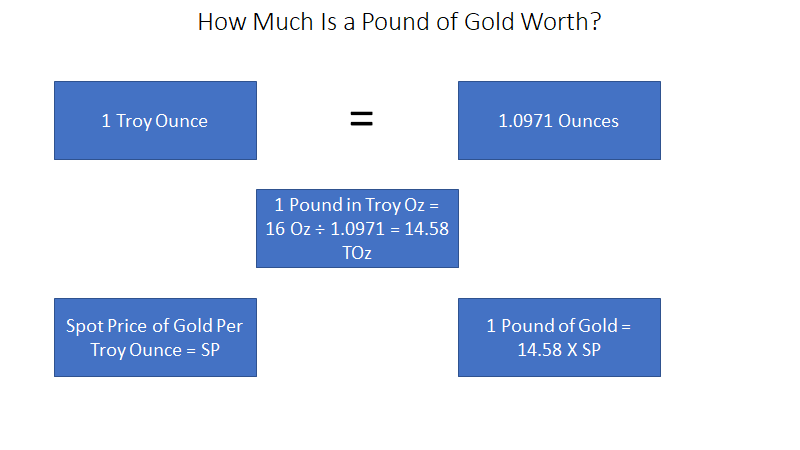
Here’s where the 14.583 number comes from: a standard pound is 16 regular ounces, and 1 troy ounce = 1.09714 regular ounces. So: 16 ÷ 1.09714 ≈ 14.583 troy ounces per pound. (If you want a deeper explanation of the two systems, see troy ounce vs ounce.)
Table of Contents
How Much Is a Pound of Gold Worth in 2026?
To find the value of a pound of gold, multiply the spot price of gold per troy ounce by 14.583. With gold spending much of 2026 above the $4,000 per ounce mark, here is what that math looks like at a few price levels:
| Spot price (per troy oz) | 14.583 × spot price | Approx. value of 1 lb of pure gold |
|---|---|---|
| $4,000 | $4,000 × 14.583 | ≈ $58,332 |
| $4,250 | $4,250 × 14.583 | ≈ $61,978 |
| $4,500 | $4,500 × 14.583 | ≈ $65,624 |
Those are examples only, since gold moves daily. The middle row is closest to where gold has been trading in September 2026, which is why “about $62,000 per pound” is a reasonable ballpark right now. As I update this in mid-September 2026, spot is sitting at $4,262.99, which works out to roughly $62,167 for a pound. For a current number, check the live spot price on our gold price page, then multiply by 14.583.
Get your free Gold IRA kit from Noble Gold to understand how physical gold can be held inside a retirement account.
Get the FREE Gold IRA Kit
A pound of gold is worth a lot of money, but exactly how much can vary depending on several factors. The value of gold is influenced by supply and demand, political and economic conditions, and shifts in global risk sentiment.
One thing to keep in mind is that a pound of gold is a large amount of precious metal. A standard pound is about 454 grams, which is just under half a kilogram. In practice, most retail buyers purchase gold in more common sizes like 1 oz coins, 10 oz bars, or 1 kilogram bars (about 32.15 troy ounces).
Various Factors Influence the Price of Gold
In addition to supply and demand, the value of gold can be influenced by political and economic conditions. For example, during periods of geopolitical instability, gold often attracts “safe haven” demand. When interest rates rise and cash or bonds offer higher yields, gold demand can soften because gold does not pay interest.
The past couple of years have been a good live demonstration. Persistent inflation concerns, heavy central bank buying, and geopolitical tensions all helped push gold from the mid $2,000s to above $4,000 per ounce, and a pound of gold gained tens of thousands of dollars in market value along the way.
Gold prices commonly respond to:
- Interest rates and bond yields
- Inflation expectations and central bank policy
- Central bank gold reserves and buying trends
- Geopolitical instability and global risk appetite
The time of year can also matter at the margin. For example, demand may rise during certain gift-giving seasons or around major cultural buying periods, which can add short-term pressure to premiums in the retail market.
In short: a pound of gold has a clear market value based on spot price, but the price you pay (or receive) in the real world also depends on product type, availability, and dealer spreads.
Spot Price & Commercial Value
The spot price of gold is the current market price of the metal, as influenced by various gold market players. The commercial value of gold is the price at which specific gold products (coins, bars, jewelry) are bought and sold in the real world.
Spot is quoted in U.S. dollars per troy ounce and reflects “pure” gold pricing. Commercial pricing adds real-world costs and premiums like fabrication, minting, shipping, inventory risk, and dealer margin. If you want to sanity-check pricing across different weights and purity levels, our gold calculators can help.
Factors that can influence the commercial price you see include:
- Craftsmanship (especially for jewelry)
- Minting and fabrication costs
- Strike quality and demand for specific coins
- Refinery and production costs
- Dealer premiums and buy/sell spreads
How Big Is the Difference Between Spot Price & Commercial Value?
The gap depends on what you’re buying and how “retail” the purchase is. Large wholesale bar transactions can trade close to spot, while smaller retail purchases usually carry higher premiums because the dealer’s costs are spread over fewer ounces.
For common bullion bars and widely traded coins, premiums are often in the low single digits (and can move higher in tight markets). Jewelry typically has a much larger markup due to design, labor, and brand positioning. Also note that jewelry is rarely made of 24-karat gold, so you must account for purity as well.
If you’re building a meaningful physical position, storage becomes part of the real-world cost equation too. At today’s prices, even a single pound of gold represents a serious sum, so it’s worth thinking this through. Here are 4 safer ways to store gold depending on whether convenience or maximum security matters most to you.
Conclusion
We have tried to answer the question “How much is a pound of gold worth?” as clearly as possible. The clean math is simple: 1 standard pound ≈ 14.583 troy ounces, so you multiply your spot price by 14.583. At current September 2026 prices, that puts a pound of pure gold at roughly $62,000.
Just remember: the “spot value” is not always the same as what you will pay or receive. Collectible and specialty products can carry extra premiums, and dealers typically buy back below retail. If you’re newer to this topic and want a broader overview of ways to get gold exposure, see our beginner guide on how to invest in gold in 2026.
Bottom Line
Investing in gold and precious metals may offer an effective way to diversify your portfolio because gold often behaves differently than stocks and bonds. If you’re considering precious metals inside a retirement account, you can review providers on our top gold IRA companies page, and if you want to dig deeper into one of our top picks, see the full Noble Gold review.
FAQ: Pounds, Ounces, and Gold Pricing
How many troy ounces are in a pound of gold?
How much is a pound of gold worth right now in 2026?
Why isn’t it 16 troy ounces in a pound?
Does purity matter when calculating a pound of gold?
Is spot price the same as what I’ll pay at a dealer?


 Gold: $4,370.24
 Silver: $67.50
 Platinum: $1,843.04
 Palladium: $1,318.51
 Bitcoin: $86,577.28
 Ethereum: $2,748.29