
 Gold IRA
 Silver
 Gold
Gold Platinum
 Palladium
 Bitcoin
 Ethereum
 Gold Calculators
 Questions? Call (626) 605-3152
How To Test Gold At Home With Toothpaste: A Simple Guide
Disclosure: We are reader-supported. If you purchase from a link on our site, we may earn a commission. Learn more
Last Updated on: 5th July 2026, 12:47 am
Gold is a precious metal with a long history of being used as currency, jewelry, and other decorative items; it's known as one of the most stable and inflation-proof investments historically. Gold is also an excellent conductor of electricity and heat, so it's often used in electronic devices like cell phones and computers.
Want gold you never have to second-guess?
The surest way to avoid fake gold is to buy verified, IRA-eligible bullion through a reputable dealer — and it can even live inside your retirement account. Noble Gold's free 2026 kit explains how to diversify your 401(k) or IRA with physical gold and silver, including how a rollover works, which coins and bars qualify, and what fees to compare.
Content doesn't constitute financial advice. Speak to your financial advisor before making any investment decision. We may earn a commission if you purchase through one of our links.
And in 2026, gold has never been more valuable. After smashing through record after record, the yellow metal hit an all-time high above $5,500 per ounce in late January 2026 and, as of this update, still trades north of $4,100 per ounce — roughly 25% higher than a year ago. Unfortunately, sky-high prices bring out counterfeiters. Fake bars with tungsten cores, gold-plated “bullion,” and misstamped jewelry are more common than ever, which makes knowing how to test your gold a genuinely useful skill.
Many people have gold sitting in their homes in the form of jewelry, inherited coins, and other keepsakes. So, how do we know if the gold we have is real? That's where gold testing comes in. By running a few simple checks, we can get a first impression of whether a piece behaves like genuine gold.
There are a few different ways to test gold at home, but one of the most talked-about is the toothpaste method. (Yes, toothpaste!)
Let's take a look at the process — and then cover several more reliable methods, including the ones professionals actually use in 2026.
Table of Contents
Gold Testing with Toothpaste
Important: At-home tests like toothpaste, magnets and float tests can sometimes help you spot obvious fakes, but they are not definitive. They can also damage your jewelry if done incorrectly. For valuable items, always confirm results with a professional jeweler or assayer.
To test gold with toothpaste, you will need the following items: a small piece of gold, toothpaste, and running water.
- First, you'll need a small piece of gold to test. It can be a coin, a ring, or anything else made of gold.
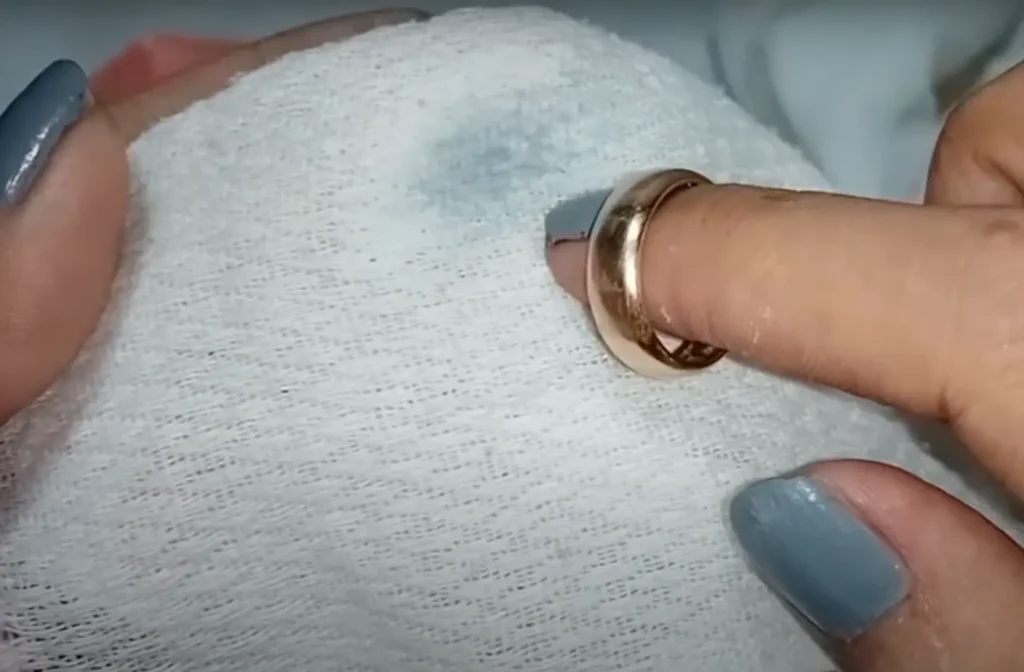
- Next, apply a small amount of toothpaste to the gold piece. Be sure to use plain white toothpaste; avoid any with colored stripes, whitening beads, or other added ingredients.
- Rub the toothpaste onto the gold for about 30 seconds. You should see a black streak begin to form.
Source: Ruth Capio
- Rinse the gold piece under running water. The black streak should disappear, leaving the gold clean.
- If the black streak rinses away cleanly, it can be a sign that your piece behaves like real gold. If the dark mark stays or the surface looks discolored, it may indicate a lower-quality alloy or plating. However, this is only a rough screening test and not a definitive proof of authenticity.
While this test is not 100% accurate, it can sometimes help you spot obvious fakes. Keep in mind that toothpaste is mildly abrasive and can scratch softer gold or wear down thin plating, so avoid using it on delicate or sentimental pieces. Think of it as a quick home experiment, not a replacement for professional testing.
Why Does This Test Work?
This test works because toothpaste contains a small number of abrasive particles. When you rub the toothpaste onto the gold, these particles work to remove a thin layer of the metal.
The mild abrasives in toothpaste can react with base metals mixed into low-quality alloys, sometimes creating a dark residue on the surface. Higher-purity gold is less reactive and more resistant to this kind of discoloration. However, because different alloys behave differently, this reaction is not consistent enough to be treated as a definitive test.
Keep in mind that this test will not work on gold-plated items. The toothpaste will remove the thin layer of gold, revealing the metal beneath. So if you're testing a gold-plated item, check for the hallmark stamp first. This stamp indicates that the item is made of real gold.
Now that you know how to test gold with toothpaste, you can at least get a first impression of whether your gold behaves like the real thing. For any piece with real financial or sentimental value, though, it is still worth getting a professional opinion.
Start with the Hallmark: The 30-Second Check
Before you reach for the toothpaste, do the easiest check of all: look for a hallmark. Most genuine gold jewelry and bullion carries a small stamp indicating its purity. On jewelry, look inside ring bands, on clasp tags, or on the back of pendants. On bars and coins, the purity is usually stamped right on the face.
Common markings include:
- Karat stamps: 10K, 14K, 18K, 22K, or 24K
- Millesimal fineness numbers: 417 (10K), 585 (14K), 750 (18K), 916 (22K), or 999/9999 (24K)
- Warning stamps: “GP” (gold plated), “GF” (gold filled), “HGE” (heavy gold electroplate), or “Gold Vermeil” — these all mean the item is not solid gold
A hallmark is a good sign, but it is not a guarantee — counterfeiters can and do fake stamps. A missing hallmark is not automatic proof of fake gold either, especially on older or handmade pieces. Treat the hallmark as your first data point, then verify with additional testing.
Other Ways to Test Gold
There are a few different ways that you can test gold at home. But unlike the Toothpaste Test, you will need to invest in a gold testing kit, which you can purchase online or at most jewelry stores. With this kit, you can test the karat of your gold and determine if it is real.
Here are a few different ways that you can test your gold:
Karat Test (Acid Test)
When it comes to gold, the word “karat” is used to denote the purity of the metal. The higher the karat number, the purer the gold. For example, 24-karat gold is 100% pure, while 18-karat gold is 75% pure.
So how do you test the karat of your gold? Here's a step-by-step guide:
- Gather your materials. You will need a gold testing kit, which can be purchased at most jewelry stores.
- Clean your gold. Use a soft cloth to wipe away any dirt or grime.
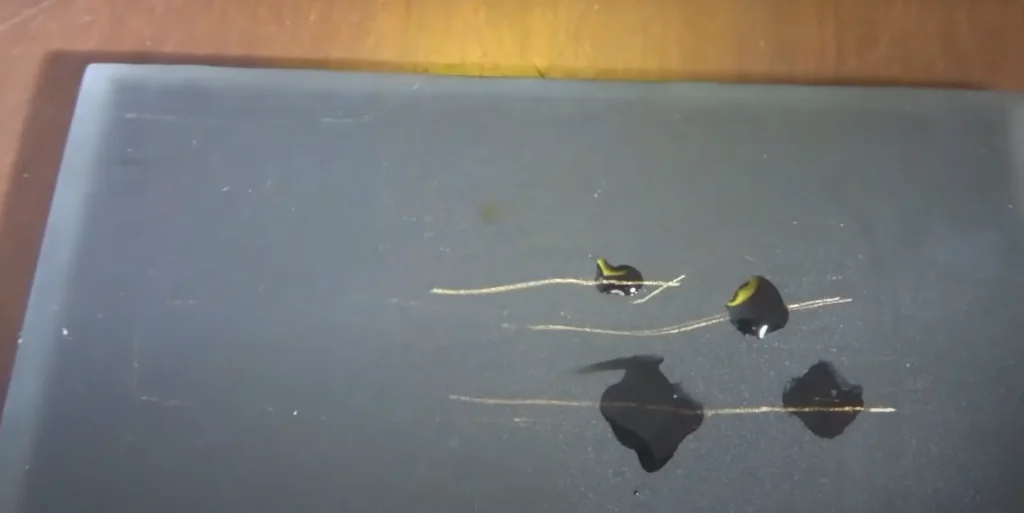
- Place the gold on the test stone. The test stone is included in your gold testing kit.
Source: Dan Hurd
- Apply the acid solution. The acid solution will react with the metal to determine its karat purity. Be sure to follow the instructions that come with your gold testing kit, and always wear gloves and eye protection — testing acids are corrosive.
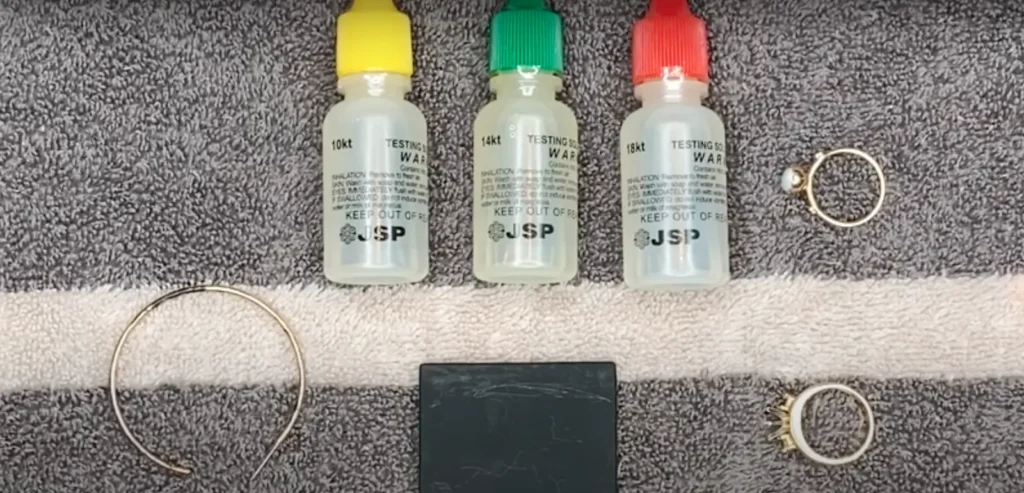
Source: Treasures and Adventures
- Compare the results. The color of the acid solution will change based on the karat purity of your gold. A chart is included in your gold testing kit to help you determine the karat purity of your sample.
The acid test remains one of the most trusted at-home methods because it tests the metal itself rather than just its surface behavior. Just note that it leaves a small mark on the piece, so use an inconspicuous spot — and skip it entirely on collectible coins, where any surface damage can destroy numismatic value.
Magnet Test
Another way that you can test your gold is with a magnet. Here's how:
- First, obtain a strong magnet. A neodymium magnet is ideal for this purpose, but any powerful magnet will do.
- Next, hold the piece of gold in question next to the magnet.
- If the gold attracts the magnet, it is not real. Gold is not magnetic, so if it sticks to your magnet then it's probably made of some other metal.
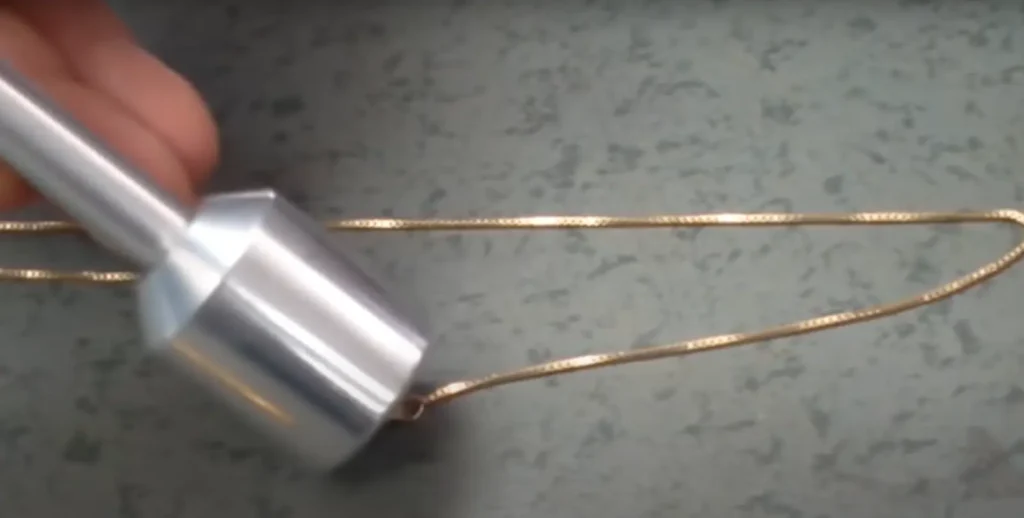
Source: Arcadia Economics
- On the other hand, if the gold is not attracted to the magnet, it simply means it is not obviously made of a strongly magnetic metal. Many fake gold alloys are also non-magnetic — tungsten, one of the most common counterfeit core materials, is not attracted to magnets — so a “pass” on the magnet test does not prove that the piece is real gold.
So there you have it. A magnet test is a quick way to catch some obvious fakes, especially pieces that are clearly made with cheap magnetic metals. Just remember that passing the magnet test does not guarantee that a piece is genuine gold, so use it as one signal among many, not your only check.
Float Test
Yet another way to test your gold is with the float test. Here's how it works:
- First, fill a cup or bowl with water.
- Next, drop your piece of gold into the water.
- If the piece sinks to the bottom, its behavior is consistent with real gold, which is very dense — roughly 19.3 grams per cubic centimeter, nearly twice as dense as lead. However, many other metals and alloys also sink, so this result on its own does not prove that the item is pure gold.
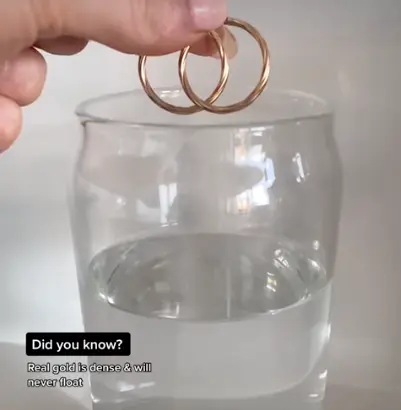
Source: LACONIC Jewellery
- If the item floats or hovers strangely in the middle of the cup, that is a strong red flag that it is not solid gold and may be hollow, plated, or made of a much lighter material.
With the float test, you can quickly and easily screen for some obvious fakes, but you should not rely on it alone to determine whether your gold is genuine.
Density (Water Displacement) Test
A more precise version of the float test is the density test, which only requires a kitchen scale and a measuring container. Weigh your item in grams, then submerge it in water and measure how many milliliters of water it displaces. Divide the weight by the displaced volume to get the density.
Pure 24K gold has a density of about 19.3 g/cm³. Because jewelry gold is alloyed with lighter metals, expect roughly 12.9–14.6 g/cm³ for 14K and 15.2–15.9 g/cm³ for 18K. If your result is far below these ranges, the piece is likely plated or hollow. One important caveat: tungsten has a density almost identical to gold (19.25 g/cm³), which is precisely why counterfeiters use it for fake bars — and why the density test alone cannot catch the most sophisticated fakes.
Electronic and XRF Testers: What the Pros Use in 2026
If you regularly buy or inherit gold, it may be worth knowing about the tools professionals rely on today — several of which have become far more accessible to ordinary collectors:
- Electronic conductivity testers: Handheld devices (such as precious metal verifiers popular with coin shops) measure a metal's electrical resistance, which is unique to gold. They are non-destructive and can even test coins through plastic holders. Entry-level units start at a few hundred dollars.
- X-ray fluorescence (XRF) analyzers: The gold standard (pun intended) at jewelers, refiners, and assay offices. An XRF gun reads the exact elemental composition of the surface in seconds without damaging the piece. Most reputable jewelers will run an XRF scan for a small fee — or free if you are selling.
- Ultrasonic thickness testing: Used on larger bars to detect tungsten inserts hiding beneath a genuine gold shell — the one type of fake that fools both the density test and surface-only methods.
For any bar or coin worth more than a few hundred dollars — which, at 2026 prices, is nearly all of them — a quick trip to a shop with an XRF or conductivity tester is cheap insurance.
Frequently Asked Questions About Testing Gold
Does the toothpaste test really work on gold?
Partially. The mild abrasives in toothpaste can produce a dark residue when they react with base metals in low-quality alloys, while high-purity gold tends to rinse clean. However, the reaction is inconsistent across different alloys, so the toothpaste test should only be used as a rough first screening — never as proof of authenticity. It can also scratch soft gold or wear through thin plating.
What is the most accurate way to test gold at home?
An acid testing kit is the most accurate at-home method because it tests the metal itself against known karat solutions. A density (water displacement) test using a kitchen scale is a good non-destructive companion check. For definitive results, have the piece analyzed with an XRF machine or electronic conductivity tester at a jeweler, coin shop, or assay office.
Does real gold stick to a magnet?
No. Gold is not magnetic, so if a piece is strongly attracted to a magnet, it is not solid gold. Keep in mind the reverse is not true: many counterfeit materials, including tungsten, are also non-magnetic, so passing the magnet test does not prove a piece is genuine.
How can I tell if my gold is real without damaging it?
Non-destructive options include checking the hallmark stamp, the magnet test, the float or density test, and professional methods like XRF analysis and electronic conductivity testing. XRF is the best choice for valuable or collectible pieces because it reads the metal's composition in seconds without leaving any mark.
What do the numbers 585, 750, and 999 mean on gold?
These are millesimal fineness marks showing gold content in parts per thousand. 585 means 58.5% pure gold (14K), 750 means 75% pure (18K), and 999 or 9999 indicates essentially pure 24K gold. Stamps like “GP,” “GF,” or “HGE” mean the item is only gold plated or gold filled, not solid gold.
How much does professional gold testing cost?
Many jewelers and coin dealers will test gold for free or a nominal fee (typically $10–$25 per item), especially if you are considering selling. A formal assay with written certification costs more but is worth it for large bars or high-value pieces. Given that gold trades above $4,000 per ounce in 2026, professional verification is inexpensive insurance.
Why are fake gold bars harder to detect than fake jewelry?
The most sophisticated counterfeit bars use a tungsten core wrapped in a shell of real gold. Tungsten's density (19.25 g/cm³) is nearly identical to gold's (19.3 g/cm³), so these fakes pass the float test, the density test, and surface tests like acid or XRF. Detecting them requires ultrasonic testing or drilling, which is why buying bullion only from reputable, accredited dealers matters so much.
Final Thoughts
Gold is a valuable metal — more valuable in 2026 than at any point in history — so it is vital to ensure you are not being scammed. Simple at-home tests can help you spot some obvious fakes and give you a first impression, but they are not foolproof. Methods that use toothpaste, magnets, or water are best thought of as quick screening tools rather than final answers.
Whether you've just received a gold gift item or come into possession of a family heirloom, it makes sense to verify your gold if you are not 100% certain of its authenticity or origin. At-home checks with magnets, water, or basic test kits can be a helpful first step, but the most reliable results still come from proper gold testing kits and professional analysis — ideally XRF or electronic conductivity testing — at a reputable jewelry store or assay office.
When in doubt, always consult a professional. A trained jeweler will be able to quickly and easily assess the quality of your gold. Want to protect your gold investments from taxation and let your holdings accrue value over time? Check out our reviews of the best gold IRA companies in America.
Ready to put your verified gold to work for retirement?
Once you know your gold is genuine, the next step many readers take is exploring a precious metals IRA. Noble Gold's free 2026 investor kit walks you through IRA-eligible metals, rollover steps, storage options, and the fees to compare before opening an account.
Content doesn't constitute financial advice. Speak to your financial advisor before making any investment decision. We may earn a commission if you purchase through one of our links.


 Gold: $4,083.72
 Silver: $59.42
 Platinum: $1,616.84
 Palladium: $1,115.79
 Bitcoin: $83,152.95
 Ethereum: $2,548.87
I would like to know how much to pay gold per gram thank you.