

 Gold IRA
 Silver
 Gold
Gold Platinum
 Palladium
 Bitcoin
 Ethereum
 Gold Calculators
 Questions? Call (626) 605-3152
Devlyn Steele Breaks Down Inflation, Retirement Risk, and the Search for Stability
Disclosure: We are reader-supported. If you purchase from a link on our site, we may earn a commission. Learn more
Last Updated on: 27th April 2026, 02:43 pm

Editor’s note: Augusta Precious Metals is a commercial precious metals company. This article summarizes comments made by Augusta’s Director of Education, Devlyn Steele, during an IncomeInsider TV interview. Readers should compare providers, understand fees and risks, and speak with a qualified financial professional before making retirement investment decisions. This content isn't financial advice and shouldn't be taken as such. All investments carry a certain level of risk, including precious metals.
Americans nearing retirement are dealing with more than normal market nerves. Inflation has stretched household budgets, interest rates have stayed restrictive, and confidence in the long-term purchasing power of the dollar has weakened.
In his appearance on IncomeInsider TV, Augusta Precious Metals‘ Director of Education Devlyn Steele argued that many retirement savers are not simply reacting to headlines. They are responding to a deeper fear that the money they worked decades to build may not go as far as they once expected.
Steele joined the show to discuss why so many people feel financially unsettled, what inflation really does to retirement planning, and why more savers are exploring alternatives outside the traditional paper-based portfolio.
He also made the case that education, not blind trust, should be the starting point for anyone reassessing their retirement strategy.
Watch the full interview here:
Table of Contents
- Retirement anxiety is really about lifestyle anxiety
- Why this moment feels different
- Inflation is not just a statistic
- The case for looking beyond paper assets
- Why more Americans still do not take that step
- Augusta’s pitch: education before action
- No cookie-cutter answer for retirement
- The bigger takeaway: get involved
Retirement anxiety is really about lifestyle anxiety
One of Steele’s clearest points was that retirement planning is not just about how many dollars someone has saved. It is about what those dollars will actually buy later.
In his framing, the real issue is whether a person’s savings can continue to support their housing, health costs, travel plans, and family goals once their working years are over. That is why he says so many people feel uneasy. The concern is not abstract. It is tied directly to the fear that their standard of living may slip in retirement.
That helps explain why market volatility and inflation hit older Americans differently than younger workers. Someone with decades left in the labor force may be able to recover from a bad stretch. Someone who is close to retirement often sees the same volatility through a very different lens. It raises a more urgent question: will my money last?
Why this moment feels different
Steele acknowledged that retirement fears are not new. Americans have lived through wars, oil shocks, recessions, and inflationary periods before. But he argued that the current environment feels different because it follows years of massive money creation, persistent inflation, and what he described as a “K-shaped economy,” where wealthier households have often benefited while middle-class Americans have felt increasingly squeezed.
In the interview, he tied today’s uncertainty to long-running government spending habits rather than any one political party. His broader point was that Washington has spent aggressively for decades, and that persistent deficits eventually show up in the form of weaker purchasing power.
Whether or not a reader agrees with every part of that analysis, it is easy to see why this message resonates with savers who feel like everyday expenses have risen faster than their ability to keep up.
Inflation is not just a statistic
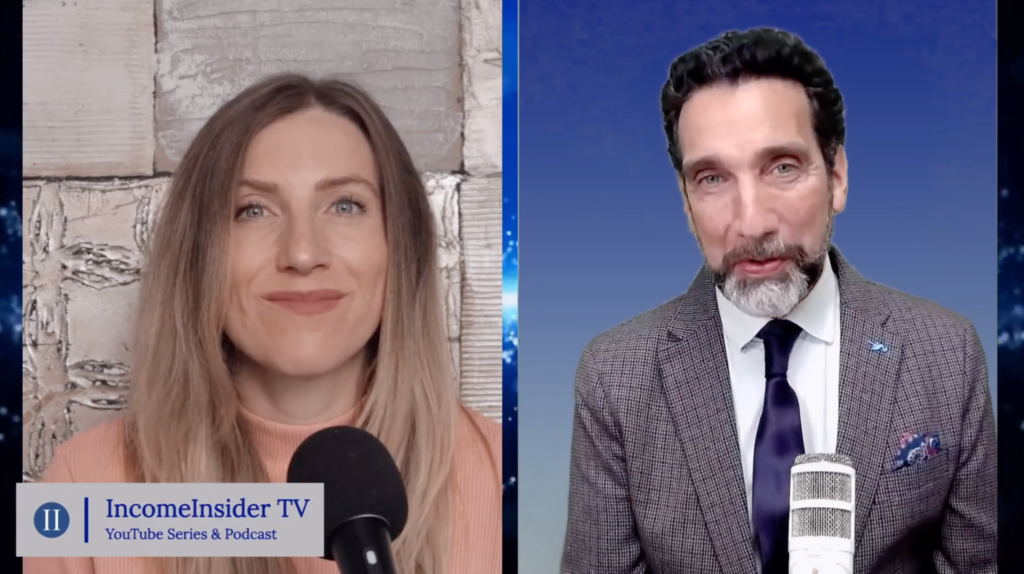
Sam Laliberte with Devlyn Steele on IncomeInsider TV
A major theme of the conversation was Steele’s argument that inflation is something people live, not just something they read about in a government report. He described inflation as a hidden tax because even when someone appears to be earning modest interest on savings, the real buying power of that money can still decline if prices rise faster.
That distinction between nominal growth and real purchasing power is especially important for retirement savers. A bank balance can look larger on paper while still leaving the owner worse off in practice.
Steele’s warning was that this disconnect causes many Americans to feel safer than they really are. What matters is not the account statement alone, but what those dollars can still do in the real world.
The case for looking beyond paper assets
Steele’s solution was not to tell people to abandon traditional investments altogether. In fact, he explicitly said he is not telling people to sell everything and move entirely into gold and silver.
His point was narrower and more strategic: many Americans are diversified only within paper assets, which still leaves them dependent on the same financial system, the same institutions, and the same currency.
That led to one of the more memorable lines from the interview. Steele said he views physical gold and silver not just as diversification of assets, but as “diversifying your trust.”
In other words, he sees precious metals as a way to reduce total dependence on banks, financial institutions, and government-managed currency. That idea will appeal especially to readers who are skeptical of debt, deficits, and long-term dollar weakness.
Why more Americans still do not take that step
The interview also explored why so many savers remain hesitant to buy physical metals even when they worry about inflation. Steele argued that most people have spent their whole lives investing passively through employer retirement plans, where they pick from broad risk categories but rarely make direct decisions about specific assets.
That leaves many people uncomfortable making an independent move for the first time.
He also pointed to the incentives built into the traditional financial system. Advisors who are paid based on assets under management often keep clients inside the products that generate those fees.
From Steele’s perspective, that helps explain why many Americans hear the same message year after year: stay in the system, stay diversified within it, and avoid alternatives that do not fit the standard product menu.
Augusta’s pitch: education before action
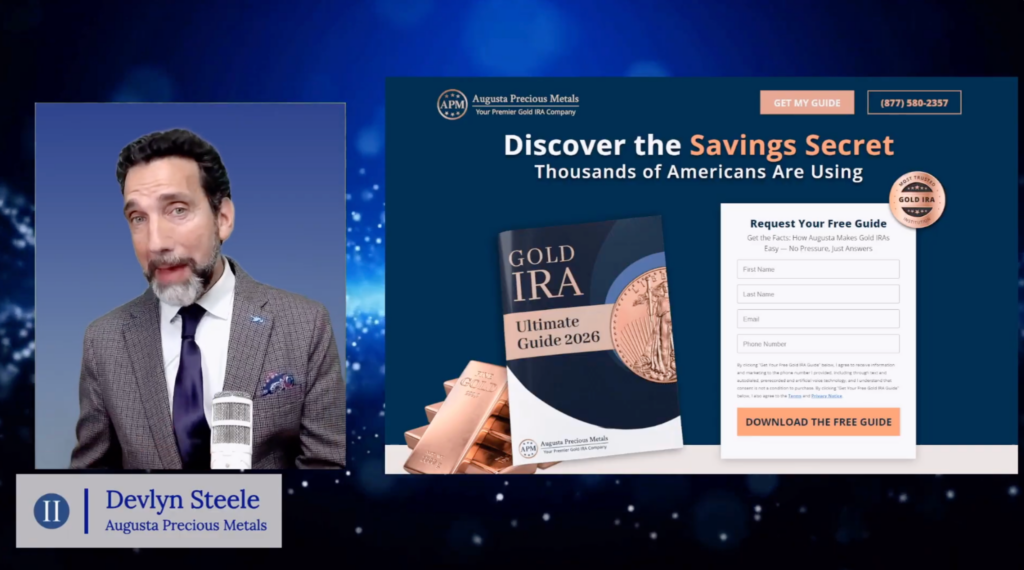
Devlyn Steele, Director of Education at Augusta Precious Metals
Because Steele works for Augusta Precious Metals, the interview naturally included a discussion of how the company positions itself. The most notable distinction he emphasized was Augusta’s education-first model.
According to Steele, Augusta does not pay its team on commission, and instead uses salaried educators to help potential customers understand the pros, risks, and mechanics of buying gold and silver.
That does not mean Augusta is presented as non-commercial. Steele openly said the company makes money on the spread between buy and sell prices. The point he wanted listeners to understand was that the people communicating with customers are not under direct pressure to close a sale in the same way a commissioned salesperson might be.
In his telling, that changes the tone of the conversation and makes it easier for people to ask questions without feeling pressured or rushed into a buying decision.
One of the stronger parts of the interview came near the end, when Steele pushed back against one-size-fits-all advice. He said broad rules like putting 10 percent of a portfolio into gold and silver can be misleading because every household is different.
Savings levels, fixed expenses, pension income, Social Security, health needs, and retirement goals all matter.
That restraint actually made the broader message more credible. Rather than promising a universal formula, Steele encouraged viewers to audit their own situation honestly.
Are their returns outpacing inflation? Are they overconcentrated in one area? Are they prepared for medical costs later in life? Are they relying on assumptions that may no longer hold in a changing economy?
The bigger takeaway: get involved
If the interview had a single unifying theme, it was this: passivity is no longer enough. Steele repeatedly returned to the idea that people spend decades working for their money, yet often spend very little time learning how to protect it.
His argument was that retirement savers need to get more involved, ask harder questions, and stop assuming that the same playbook that worked in the past will automatically work in the future.
Whether a reader ultimately agrees with Augusta Precious Metals’ preferred solution or not, that core message is hard to dismiss. A changing economy demands more attention from the people whose futures depend on it. For Americans nearing retirement, education may be the first and most important step.


 Gold: $4,123.78
 Silver: $56.62
 Platinum: $1,637.97
 Palladium: $1,110.40
 Bitcoin: $81,878.93
 Ethereum: $2,405.21