

 Gold IRA
 Silver
 Gold
Gold Platinum
 Palladium
 Bitcoin
 Ethereum
 Gold Calculators
 Questions? Call (626) 605-3152
Gold in a Roth IRA: Rules, Fees & Recommendations (2026)
Disclosure: We are reader-supported. If you purchase from a link on our site, we may earn a commission. Learn more
Table of Contents
- What is a Roth IRA and can it hold gold?
- Roth IRA vs. Traditional IRA in plain English
- So how does a Roth IRA hold physical gold?
- Roth IRA rollover restrictions and limitations
- Roth IRA vs. Traditional IRA vs. SDIRA vs. other retirement accounts
- Roth IRA limits
- Roth IRA calculator
- Popular Roth IRA custodians (typically do not allow physical gold bullion inside the Roth)
- Where people go next if they want physical gold
- Roth IRA FAQ
What is a Roth IRA and can it hold gold?
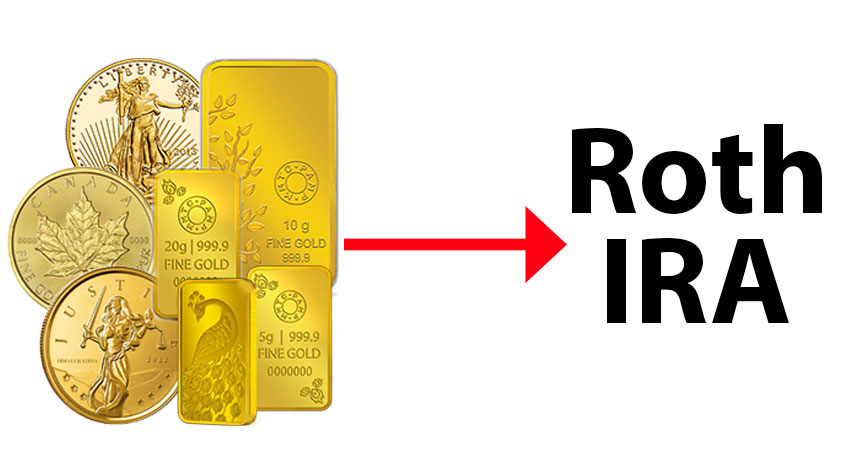
A Roth IRA is a tax-advantaged individual retirement account that works a little differently than a traditional IRA. With a traditional IRA, contributions may be tax-deductible (depending on your income and workplace plan coverage), growth is tax-deferred, and withdrawals in retirement are generally taxed as ordinary income. With a Roth IRA, you contribute after-tax dollars and, if you follow the rules, qualified withdrawals in retirement can be tax-free.
Quick answer: yes, a Roth IRA can hold IRS-approved physical gold, but only through a self-directed Roth IRA with a custodian that allows precious metals. The standard Roth accounts at Vanguard, Fidelity and Schwab cannot hold bullion. Everything below, including the 2026 contribution limits, was re-verified in October 2026.
Free Roth IRA Gold Guide (GoldenCrest Metals)
If you’re exploring physical gold in a Roth IRA, this guide covers the questions people get stuck on:
rollover vs transfer vs Roth conversion, eligible gold, approved storage, and the fee items worth asking about upfront.
Disclosure: If you request the guide through our link, we may earn a commission at no extra cost to you.
Roth IRA and gold bullion
Quick answer: Yes, a Roth IRA can hold physical gold, but typically only through a self-directed Roth IRA structure where an IRA custodian and an approved depository handle custody and storage. Standard Roth IRAs at big brokerages usually do not let you buy and store physical bullion inside the account.
Roth IRA vs. Traditional IRA in plain English
These two accounts share the same “IRA” framework, but the tax treatment is different:
- Traditional IRA: contributions may be tax-deductible (depending on income and workplace plan coverage), growth is tax-deferred, withdrawals are generally taxed as ordinary income.
- Roth IRA: contributions are made with after-tax dollars, growth can be tax-free, and qualified withdrawals can be tax-free.
Unlike traditional IRAs, Roth IRAs do not have required minimum distributions (RMDs) during the original owner’s lifetime. Traditional IRA RMD rules depend on age and can change over time. For the current baseline rules and deadlines, see the IRS guidance on required minimum distributions.
👍 Pros of using a Roth IRA for physical gold
- Tax-free retirement withdrawals (when qualified): if you follow the Roth rules, gains can come out tax-free.
- No RMDs for the original owner: helpful for long-term planning and legacy goals.
- Potential diversification: some investors like having a small slice of hard assets alongside stocks and bonds, especially if they already have a large paper-asset allocation.
👎 Cons and limitations to know
- Most “normal” Roth IRAs cannot hold bullion: brokerages typically allow gold exposure via ETFs or mining stocks, not physical coins/bars stored for the IRA.
- More moving parts: precious metals IRAs involve custodians, storage, and transaction processes that are different from clicking “buy” on a stock.
- Costs matter: storage and administrative fees can change the math, especially for smaller account sizes. See our breakdown of gold IRA costs and fees.
So how does a Roth IRA hold physical gold?
Most investors use a self-directed IRA approach when they want physical metals inside an IRA. This matters because the IRS treats most metals as “collectibles,” with an important exception for certain bullion products when they are held properly under an IRA custodian arrangement.
In practice, a “Roth IRA that holds gold” usually means:
- You open a self-directed Roth IRA with a custodian that supports precious metals.
- You fund it (via contribution, transfer, or rollover, depending on your situation).
- The custodian executes the purchase of IRS-eligible bullion, and the metals are stored at an approved facility (not in your home).
If you want to go deeper on storage and how depositories work, our guide on IRS-approved depositories and storage options lays it out clearly.
Important “don’t mess this up” note
A very common mistake is assuming you can “buy gold for my IRA” and then personally store it at home. That can create compliance issues and potential disqualification risk. If you’re unsure, treat this as a tax and custody question first, not a metal question.
Roth IRA rollover restrictions and limitations
You can move money between retirement accounts, but the terminology matters:
- Transfer: typically a direct trustee-to-trustee movement between IRAs. These are commonly used and generally not limited the same way as rollovers.
- Rollover: can include situations where funds are distributed and then redeposited within the allowed window. These can trigger the “one-per-year” rule in certain cases.
As a general safety rule, most people prefer a direct custodian-to-custodian movement when possible to reduce withholding and timing mistakes. For the exact rules and exceptions, the IRS guidance on rollovers of retirement plan and IRA distributions is the best reference.
If you specifically want the rollover process for a precious metals IRA, our step-by-step Gold IRA rollover guide walks you through it.
Quick checklist for Roth IRA gold moves
Most readers hit the same snag: “Is this a rollover, a transfer, or a Roth conversion?”
GoldenCrest Metals’ free guide includes a simple checklist to help you avoid avoidable penalties and paperwork headaches.
Disclosure: If you request the guide through our link, we may earn a commission at no extra cost to you.
Roth IRA vs. Traditional IRA vs. SDIRA vs. other retirement accounts
Here is a simple comparison table. “Roth option” refers to Roth tax treatment, which can exist inside multiple plan types. “Maybe” indicates gold exposure can depend on the plan provider (for example, some employer plans allow gold-related funds, while others do not). Physical bullion inside an IRA usually requires a self-directed structure.
| Plan Type | Sponsorship | Key 2026 Limit (high level) | Roth Option? | Allow Gold Stocks? | Allow Gold ETFs? | Allow Gold Bullion? |
|---|---|---|---|---|---|---|
| 401(k) | Private employer | $24,500 employee deferral (catch-up rules vary by age) | Yes | Maybe | Maybe | No |
| Solo 401(k) | Self-employed | Up to $72,000 total (plus catch-up if eligible) | Yes | Yes | Yes | Maybe |
| 403(b) | Non-profit / schools | $24,500 employee deferral (catch-up rules vary by age) | Yes | Maybe | Maybe | No |
| 457(b) | Government / tax-exempt | $24,500 employee deferral (catch-up rules vary by age) | Yes | Maybe | Maybe | No |
| SIMPLE IRA | Small employers | $17,000 salary deferral (catch-up rules vary) | Maybe | Yes | Yes | Maybe |
| SEP IRA | Self-employed / business | Up to $72,000 employer contribution (formula-based) | No | Yes | Yes | Maybe |
| Traditional IRA | Individual | $7,500 (or $8,600 if 50+) | Yes | Yes | Yes | No |
| Roth IRA | Individual | $7,500 (or $8,600 if 50+), subject to income rules | Yes | Yes | Yes | No |
| Self-Directed IRA (SDIRA) | Individual | Same IRA contribution limits (structure varies) | Yes | Yes | Yes | Yes |
| Thrift Savings Plan (TSP) | Federal / military | $24,500 employee deferral (catch-up rules vary by age) | Yes | No | No | No |
Note: These are simplified comparisons. If you want the official annual updates (including income phase-outs), see the IRS announcement on 2026 retirement plan and IRA contribution limits.
Roth IRA limits
The IRS sets annual contribution limits and income eligibility rules for Roth IRA contributions. These numbers can change each year. For 2026, the IRA contribution limit increased to $7,500, and the IRA catch-up contribution for individuals 50+ increased to $1,100 (total $8,600). You can verify the newest published limits and Roth income phase-out ranges in the IRS update on 2026 contribution limits.
- There are income phase-outs for direct Roth IRA contributions.
- Excess contributions can trigger an excise tax if not corrected.
- Early withdrawals can trigger taxes and penalties depending on what you withdraw and when.
Roth IRA calculator
How much you invest for retirement depends on your savings rate, time horizon, and expected returns. If you want a quick estimate, you can use this Roth IRA calculator.
Popular Roth IRA custodians (typically do not allow physical gold bullion inside the Roth)
Most large brokerages do not let you buy and store physical bullion inside a standard Roth IRA. What they usually allow instead are “paper gold” options such as gold ETFs, gold mutual funds, or mining stocks. If you want to understand the tradeoffs, see our breakdown of physical gold vs paper gold.
Vanguard Roth IRA
Vanguard is known for low-cost index funds and broad access to mutual funds and ETFs. In a typical Vanguard Roth IRA, you can get gold exposure through certain funds, but you generally cannot purchase IRS-eligible physical bullion held in custody for the IRA.
Fidelity Roth IRA
Fidelity offers a wide range of stocks, ETFs, mutual funds, and research tools. Here is their product page for a Fidelity Roth IRA. Like most mainstream brokerages, physical bullion in the Roth is generally not the default option, but gold-related securities may be available.
Charles Schwab Roth IRA
Schwab is another major brokerage with broad access to stocks, ETFs, and mutual funds. Here is their product page for a Charles Schwab Roth IRA. Physical bullion storage for the IRA typically requires a self-directed precious metals IRA setup rather than a standard brokerage Roth IRA.
Where people go next if they want physical gold
If your goal is physical bullion, you’ll usually be comparing specialized providers, custodians, and fee structures. Our updated list of top gold IRA companies is a solid starting point.
Not sure if you’re even the “gold IRA type”? Take our Should you buy gold? (2026 quiz) and get a clearer answer based on your situation.
Before you buy gold for a Roth IRA, grab GoldenCrest’s free guide
If your goal is tax-free retirement withdrawals, the details matter. This guide helps you sanity-check:
- Which gold products are typically IRA-eligible (and which are not)
- Why storage rules matter (and what “approved depository” really means)
- Which fees to ask about before you move any retirement funds
Disclosure: If you request the guide through our link, we may earn a commission at no extra cost to you.
Request the Free GuideRoth IRA FAQ
How do you open a Roth IRA?
You can open a Roth IRA through most brokerages online. If you want physical gold inside an IRA, you usually need a self-directed Roth IRA with a custodian that supports precious metals and an approved storage arrangement.
When did the Roth IRA start?
Roth IRAs were created by the Taxpayer Relief Act of 1997 and named after Senator William Roth.
How does a Roth IRA work?
You contribute after-tax dollars, the account can grow tax-free, and qualified withdrawals in retirement can be tax-free if you follow IRS rules.
How much can I contribute to a Roth IRA?
For 2026, the IRA limit is $7,500, plus a $1,100 catch-up contribution if you are 50 or older. Income rules may reduce or eliminate your ability to contribute directly.
When can you withdraw from a Roth IRA?
Rules depend on your age, how long the account has been open, and whether you are withdrawing contributions or earnings. Qualified withdrawals are generally tax-free, but early withdrawals can trigger taxes and penalties in some cases.
Who can open a Roth IRA?
Generally, anyone with earned income who meets IRS income eligibility requirements (or uses an allowed workaround such as a backdoor strategy, when appropriate) can open one.
How many Roth IRAs can you have?
You can have multiple Roth IRAs, but your annual contribution limit applies across all of them combined.
What is the difference between an IRA and a Roth IRA?
“IRA” is the account structure. “Roth” refers to tax treatment. Traditional IRAs often provide tax-deferred growth with taxable withdrawals, while Roth IRAs use after-tax contributions with potential tax-free qualified withdrawals.
Can a Roth IRA invest in physical gold?
Typically yes, but only through a self-directed Roth IRA structure with proper custody and approved storage. Standard brokerage Roth IRAs usually do not allow physical bullion inside the account.
What types of gold can you invest in with a Roth IRA?
Only certain bullion coins and bars that meet IRS fineness standards and are handled through the correct IRA custody and storage process. Many “collectible” coins are not allowed inside an IRA.
What is the difference between physical gold and “paper gold”?
Physical gold means actual coins or bars held in custody. Paper gold typically means ETFs, mutual funds, or mining stocks that track gold or gold-related businesses but do not involve holding the metal itself.
What is a Roth IRA rollover vs a transfer?
Transfers are usually trustee-to-trustee moves between IRAs. Rollovers can involve a distribution and redeposit, which introduces timing rules and potential withholding issues. Many people prefer direct custodian-to-custodian movements when possible.
Are there IRS rules for IRA rollovers and transfers?
Yes. The IRS publishes rollover and transfer guidance, including timing rules and restrictions. If you are unsure, confirm the rules and consider professional tax guidance before moving retirement funds.
Do Roth IRAs have required minimum distributions (RMDs)?
Roth IRAs generally do not have RMDs during the original owner’s lifetime. Inherited Roth IRAs can have required distribution rules depending on the beneficiary situation.
FTC Disclosure: We are an independent blog that aims to provide useful information for retirement account owners interested in alternative assets like precious metals. However, our content does not constitute financial advice. Please speak to a qualified financial advisor and tax professional before making any investment decision. Past performance does not guarantee future results.

 Gold: $4,165.41
 Silver: $56.99
 Platinum: $1,640.40
 Palladium: $1,113.54
 Bitcoin: $81,241.80
 Ethereum: $2,405.90